Prerequisites
Permissions to View/Edit Alerts Settings required
Overview
The structuring inbound alert detects players who may be attempting to avoid financial reporting thresholds by breaking up large deposits into smaller amounts over time. You configure the alert by defining thresholds, the number of occurrences, and risk-based factors. This allows the system to identify patterns that suggest suspicious behavior and assign a risk score accordingly.
Steps to Configure Structuring Inbound Alert
Access the Alert Settings Page
Click the gear icon in the bottom-left navigation bar.
Select the AML module, then click Alerts (Beta) in the left-hand menu.
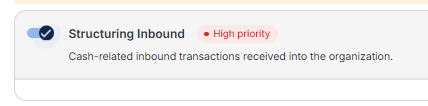
Choose the property at the top of the page, then open the Structuring Inbound card.
Set the Detection Window
The detection window defines how far back the system looks for transactions each time alerts are run.
A common setting is 30 days, meaning the system analyzes the past 30 days of activity.
Ensure the alert window is equal to or longer than the frequency of alert runs (e.g., if alerts run every 14 days, the window should be at least 14 days).
A shorter window may result in gaps in transaction analysis, potentially missing structuring behavior.
Consult your Client Success Manager before reducing the alert window below 30 days.

Configure the Detection Criteria
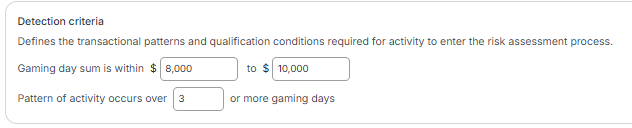
Gaming Day Sum: Define the daily transaction amount range that may indicate structuring (e.g., $8,000–$10,000). Only days within this range are considered.
Pattern of Activity: Set how many qualifying days within the alert window are needed to establish a pattern. A single occurrence typically does not trigger an alert.
Define Primary Risk Factors
These set the base Confidence Score for activity that meets the detection criteria.
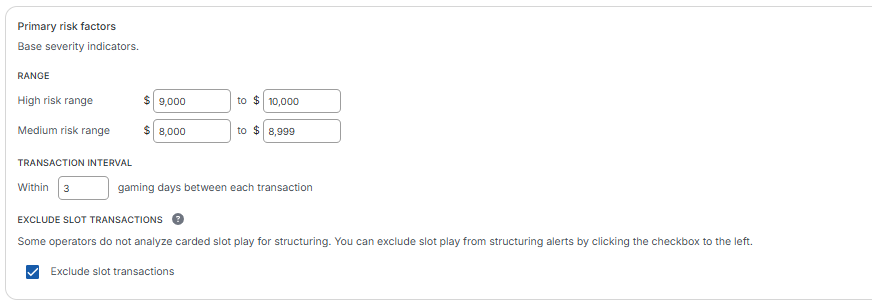
Range: Set the High risk range and Medium risk range. Days in the high risk range get a higher base score than days in the medium risk range.
Transaction Interval: Define how close in time transactions must be to indicate structuring. For example, if transactions are more than 3–4 days apart, they may not be considered part of a structuring pattern.
Exclude Slot Transactions: Some operators choose not to analyze carded slot play (e.g., Slot Bill In or SBI) for structuring. You can exclude these transactions by turning on Exclude slot transactions on the Risk assessment tab. This ensures that slot activity is not factored into the alert logic if it is not relevant to your compliance model.
Set the Contributing Risk Factors
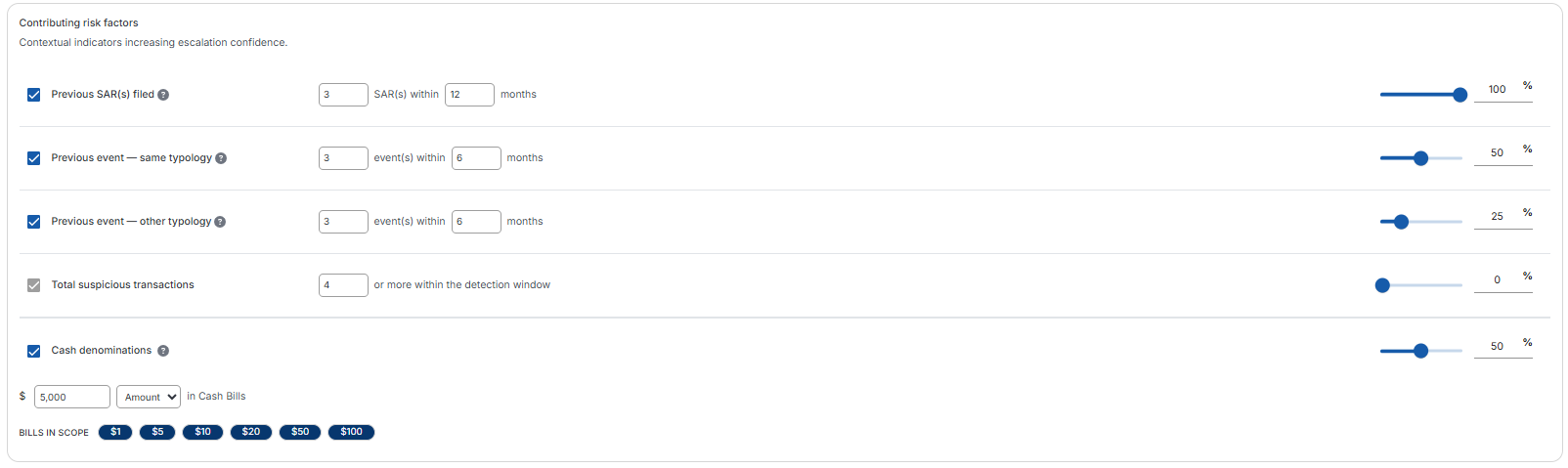
Contributing risk factors increase the Confidence Score. On Active alerts, a higher score can decide whether an event is escalated to an alert.
These factors help validate suspicious activity. If a factor doesn’t add confidence, clear its checkbox to turn it off.
If no contributing risk factors are turned on, the Confidence Score is based solely on the primary and mitigating risk factors.
Set the Mitigating Risk Factors
Mitigating risk factors decrease the Confidence Score. On Active alerts, a lower score can keep an event below the escalation threshold, so it is not escalated to an alert.
These factors reduce confidence in suspicious activity. Clear the checkbox for any that don’t apply to your risk model.
If none are turned on, the Confidence Score reflects only the primary and contributing risk factors.

For more information on how contributing factors influence the Confidence Score, see the knowledge base article How is the alert score calculated.
For Active Alerts
If Active alerts are turned on for your organization, the structuring inbound alert is set up in Settings > Alerts (Beta). Choose the property at the top of the page, then open the Structuring Inbound card. The card has four tabs:
Detection criteria – The Detection window (the standard number of days, or a Custom window), the range the gaming day sum must fall within, and how many gaming days the Pattern of activity must occur over. Activity that meets these is recorded as an event.
Risk assessment – The Primary risk factors (the high and medium risk ranges, the Transaction interval and Exclude slot transactions), plus the Contributing risk factors and Mitigating risk factors, each with a weight. Together they produce the event's Confidence Score.
Escalation qualification – The Threshold score an event's Confidence Score must reach to become an alert. If pattern qualification is available for your property, you can also require a Minimum qualifying events count within an Evaluation period before an alert is produced.
Escalation prioritization – The High priority threshold. Alerts at or above this Confidence Score are marked High Priority.
On Active alerts, this alert type can include the Cash - Denominations contributing factor. It looks for cash transactions in the bill denominations set in your alert settings. For details, see the contributing factors article.
Expected Result
Once configured, the system will generate alerts when transactions meet the defined thresholds and patterns. The alert score will reflect the influence of primary, contributing, and mitigating factors. If no transactions meet the criteria, no alert will be produced.
Frequently Asked Questions
What’s the difference between structuring inbound and outbound alerts?
Structuring inbound alerts focus on detecting patterns in incoming funds (e.g., deposits), while structuring outbound alerts analyze outgoing funds (e.g., withdrawals or transfers). Both use similar logic but apply to different transaction directions.
Can I use the same thresholds for all properties or player segments?
Yes, but it is not recommended. While the system allows you to apply the same thresholds across properties, doing so may lead to inaccurate results. Thresholds should be tailored based on player behavior, property risk profiles, and regulatory expectations. A one-size-fits-all approach can increase false positives or cause you to miss meaningful alerts.
What happens if I disable all contributing and mitigating factors?
The alert will still be generated if the threshold and primary factors are met. The alert score will be based solely on the primary factors.
Are alerts retroactive if I change the configuration?
No. Changes to alert settings only apply to newly generated alerts. Historical alerts are not recalculated.
How do I know if my alert settings are too strict or too lenient?
Monitor alert volume and review alert quality. If too many alerts are generated or too few are meaningful, consider adjusting thresholds or factor weights to better align with your risk tolerance.