Prerequisites
Permissions to View/Edit Alerts Settings required
Overview
This alert is designed to detect accounts with unused funds over a defined period of inactivity. It helps identify potential risks such as abandoned accounts or suspicious inactivity patterns. You can configure the alert by setting the dormancy threshold and inactivity period, and turning on contributing risk factors to influence the Confidence Score.
For Active Alerts
If Active alerts are turned on for your organization, this alert is set up in Settings > Alerts (Beta). Choose the property at the top of the page, then open the Dormant Funds card. The card has four tabs:
Detection criteria – The Detection window (the standard number of days, or a Custom window), the Dormancy threshold and the Inactivity period. Activity that meets these is recorded as an event.
Risk assessment – The Contributing risk factors, each with a weight. This alert type has no mitigating risk factors. Together with the dormant balance and the length of inactivity, they produce the event's Confidence Score.
Escalation qualification – The Threshold score an event's Confidence Score must reach to become an alert. If pattern qualification is available for your property, you can also require a Minimum qualifying events count within an Evaluation period before an alert is produced.
Escalation prioritization – The High priority threshold. Alerts at or above this Confidence Score are marked High Priority.
On Active alerts, this alert type can include the Cash Denominations contributing factor. It looks for cash transactions in the bill denominations set in your alert settings. For details, see the contributing factors article.
Steps to Configure Dormant Funds Alert
Access the Alert Settings Page
Click the gear icon in the bottom-left navigation bar
Select the AML module
Click Alerts (Beta) in the left-hand menu
Choose the property at the top of the page, then open the Dormant Funds card.

Set the Detection Window
Defines how far back the system looks for transactions
A common setting is 30 days
The alert window should be equal to or longer than the frequency of alert runs
Shorter windows may result in missed activity

Configure the Detection Criteria
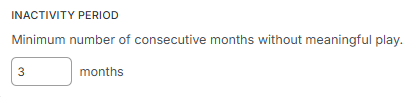
Inactivity period: Set the minimum number of consecutive months without meaningful play. If no account activity is detected during this period and the balance is at or above the dormancy threshold, the activity is recorded as an event. The base Confidence Score has two parts: one reflects how large the balance is relative to the dormancy threshold, and the other rises the longer the funds have been idle, in whole months. Both are capped, so a larger balance and a longer idle period give a higher score
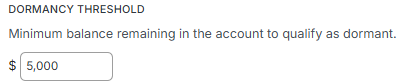
Dormancy threshold: Set the minimum balance that must remain in the account for it to qualify as dormant.
Set the Contributing Risk Factors
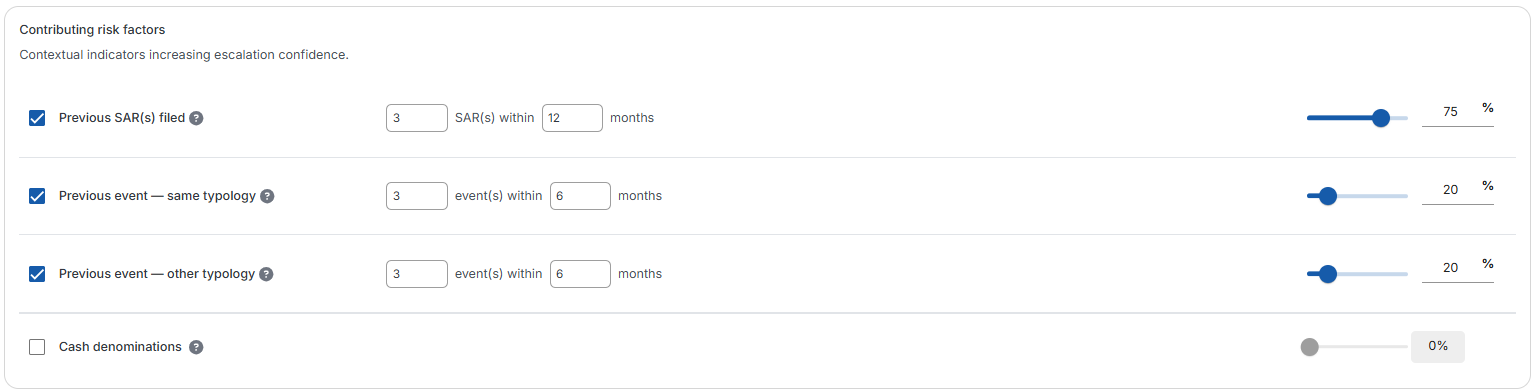
Contributing risk factors increase the Confidence Score. On Active alerts, a higher score can decide whether an event is escalated to an alert
Each has a weight. The factors are Previous SAR(s) filed, Previous event — Dormant Funds, Previous event — Other and Cash Denominations. Clear the checkbox to the left of a factor to turn it off if it doesn’t fit your risk model
Mitigating Risk Factors
There are no mitigating risk factors for this alert
For more information on how contributing factors influence the Confidence Score, see the knowledge base article How is the alert score calculated.
Expected Result
Once configured, the system will record a Dormant Funds event when a player’s most recent account activity is at least the inactivity period old and the account balance is at or above the dormancy threshold. On Active alerts, the event becomes an alert if its Confidence Score reaches the Threshold score. The Confidence Score will reflect any contributing risk factors turned on. If no qualifying inactivity is found, no alert will be produced.
Frequently Asked Questions
What defines “dormant” in this alert?
Dormancy is based on the Inactivity period, the minimum number of consecutive months without meaningful play, and on the Dormancy threshold, the minimum balance remaining in the account. You set both in the alert settings.
Will the alert trigger multiple times if the player remains inactive?
If a new event repeats an earlier Dormant Funds event for the same player, for example because the detection window overlaps a previous run, Kinectify treats it as a duplicate and does not create a second alert. The duplicate is kept in the Non-Escalated Events log.
Are alerts retroactive if I change the configuration?
No. Changes only apply to newly generated alerts. Historical alerts are not recalculated.